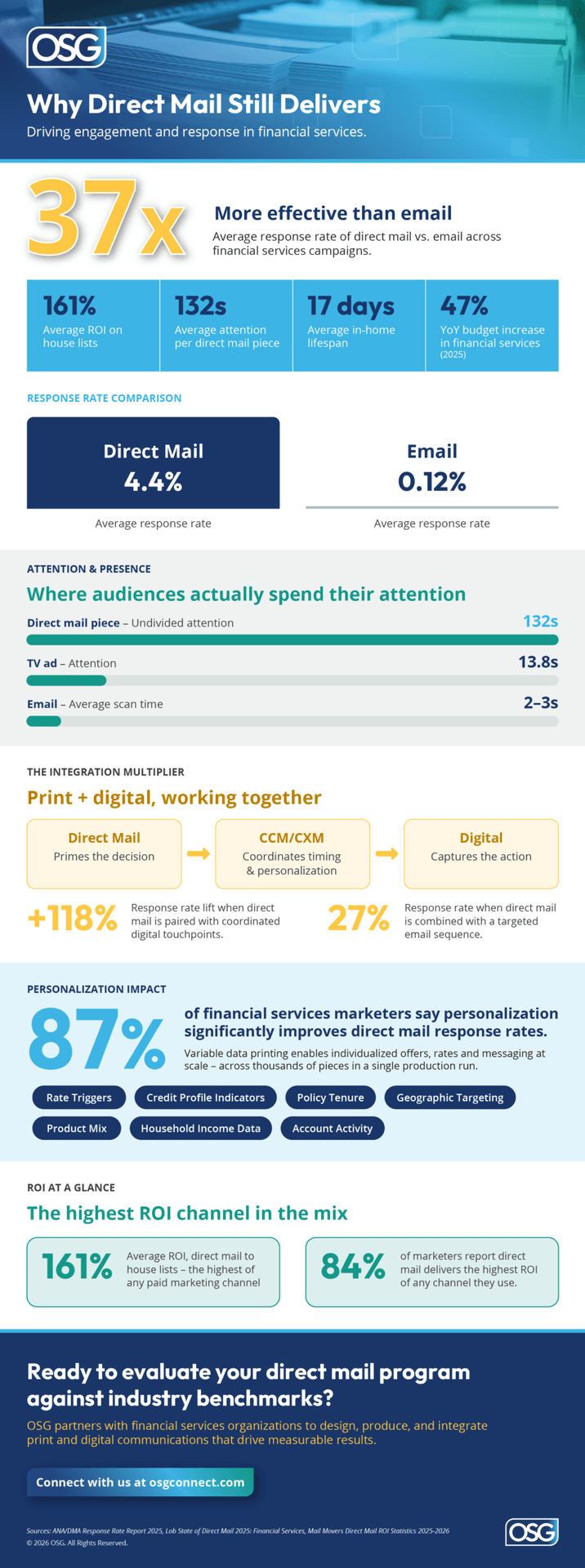
Driving Engagement and Response in Financial Services
Higher response than email
Average ROI, house list
Average in-home lifespan
Budget increase YoY
The Inbox Is Crowded. The Mailbox Is Not.
Financial services organizations face a paradox: they have more channels than ever to reach customers, yet meaningful engagement has never been harder to earn. Email open rates hover in the low twenties. Digital ads scroll past in milliseconds. Social feeds are algorithmic noise.
Meanwhile, something unexpected is sitting in your customer’s mailbox – and getting read.
Direct mail response rates in financial services average 3.95%, compared to 0.12% for email. That is more than 30 times the response. And that gap is not narrowing. As digital fatigue compounds across every demographic, physical mail is reclaiming its position as one of the most effective tools in the financial marketer’s arsenal.
This is not nostalgia. It is strategy.
The Numbers That Should Change Your Channel Mix
Before writing off print as a legacy tactic, consider what the data actually says:
- 4% average response rate for direct mail vs. 0.12% for email (ANA/DMA 2025)
- 161% average ROI from direct mail to house lists – the highest of any paid marketing channel
- 132 seconds of undivided attention from a direct mail piece vs. 13.8 seconds for a TV ad
- 17-day average in-home lifespan – your message stays present long after an email is deleted
Financial services increased direct mail volume 43% YoY – from 48.3M to 69M pieces in 2025 – with budget investment growing at 47%
Why Financial Services Is Uniquely Suited to Direct Mail
Trust. A well-designed piece arriving by mail signals legitimacy in ways a cold email never can. Consumers have been conditioned to be skeptical of digital outreach – phishing, spoofing, and spam have trained them to hesitate. A printed statement, a mortgage pre-approval letter, an insurance renewal notice – these arrive with an implicit credibility that digital struggles to match.
Permanence. Financial decisions are rarely impulsive. A customer considering a refinance or reviewing insurance options benefits from a communication they can return to, highlight, and share with a partner or advisor. Print makes that possible. Email does not.
Compliance. For regulated industries, physical mail provides documented, auditable delivery. Required disclosures, adverse action notices, and regulatory correspondence often require print by statute – making a sophisticated direct mail operation not just a marketing advantage, but an operational necessity.
The Integration Multiplier: Print Plus Digital
The most compelling case for direct mail is not print versus digital – it is print and digital working in concert.
When direct mail is integrated with coordinated digital touchpoints, response rates increase by 118% compared to mail alone. Campaigns that pair a physical piece with an email sequence have demonstrated response rates approaching 27%.
The mechanism is straightforward: physical mail creates awareness and attention; digital follow-up captures intent and drives action. A mortgage customer receives a personalized refinance offer by mail. Two days later, a targeted email arrives with the same rate quote and a link to start an application. The physical piece primed the decision; the digital piece closed the loop.
This integration is where Customer Communications Management (CCM) and Customer Experience Management (CXM) become strategically critical. Coordinating message consistency, timing, and personalization across print and digital touchpoints – at scale – requires more than a campaign platform. It requires infrastructure that treats every customer communication as part of a unified experience.
Personalization: The Variable That Changes Everything
Eighty-seven percent of financial services marketers report that personalization significantly improves direct mail response rates.
Variable data printing (VDP) makes this possible at scale. A single print run can produce thousands of individually personalized pieces, each with a unique rate, a relevant product message, or a specific call to action tied to the recipient’s profile. The technology has matured dramatically; the unit economics now support personalization across segments that would have been cost-prohibitive a decade ago.
For mortgage originators running one-time refinance campaigns, personalized direct mail tied to rate triggers produces dramatically better pull-through than batch-and-blast approaches. For insurance carriers at renewal season, a piece that reflects the policyholder’s coverage history and includes a relevant cross-sell offer outperforms a generic renewal notice in both response and retention.
Practical Applications Across Financial Services
- Banks and Credit Unions
Acquisition campaigns for checking, savings, and credit products. Cross-sell campaigns to existing households. Annual disclosure mailings. HELOC and personal loan pre-approval offers. Community reinvestment compliance communications. - Mortgage
Rate-triggered refinance campaigns. Purchase lead generation in targeted markets. Pre-approval confirmation packages. Post-close onboarding and service communication. Annual statements and escrow analysis. - Insurance
Policy renewal notices and premium change communications. Cross-sell and upsell campaigns at renewal. New policyholder welcome packages. Claims correspondence and EOB communications. Agent and broker recruitment. - Wealth Management and Retirement
Quarterly statements and required disclosures. Fund performance summaries. Client appreciation and referral campaigns. Prospecting mailings to high-net-worth households.
The Operational Imperative
For financial services organizations managing high volumes of customer communication, direct mail is not just a channel – it is an infrastructure question.
The difference between a marketing team that sends direct mail and an organization that optimizes it is significant. Postage efficiency, data hygiene, print quality, compliance accuracy, delivery traceability, digital integration – each variable affects cost, compliance, and results.
Organizations that treat their print and mail operation as a strategic capability, rather than a vendor relationship, consistently outperform those that treat it as a commodity. That means investing in CCM solutions that enforce message consistency and compliance, working with production partners who can execute personalization at scale, and building the digital bridges that turn a mailed piece into a multichannel experience.
The Bottom Line
Direct mail is not a fallback for when digital underperforms. In financial services, it is a primary driver of response, trust, and customer lifetime value – particularly when it is integrated into a broader communications strategy that recognizes how customers actually make financial decisions.
The mailbox is not the past. For banks, mortgage lenders, and insurers willing to invest in it intelligently, it is a competitive advantage hiding in plain sight.
Ready to evaluate your direct mail program against industry benchmarks?
OSG partners with financial services organizations to design, produce, and integrate print and digital communications that drive measurable results.