Here’s What It’s Really Costing You
If you’re a CFO or operations leader, your in-house print operation probably looks manageable on paper. Equipment lease payments. Paper and consumables. A few FTEs. The budget line item appears contained.
But the actual cost of keeping print in-house is almost always significantly higher than what’s visible on the surface — and in regulated industries like healthcare, financial services, insurance, and government, the gap between the visible budget and the true cost can be staggering.
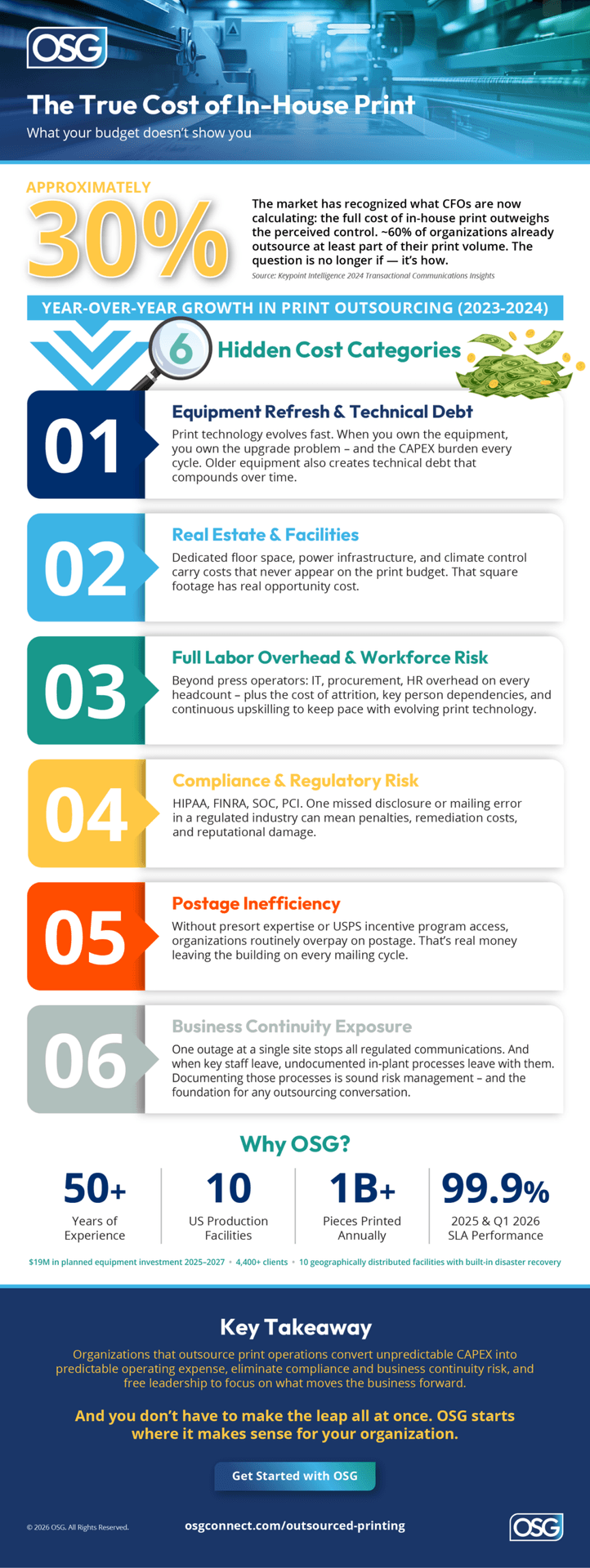
The market has started to recognize this. According to Keypoint Intelligence’s 2024 Transactional Communications Insights report, print outsourcing grew approximately 30% year over year from 2023 to 2024 — and roughly 60% of organizations with in-house print operations already outsource at least a portion of their volume. The trend line is clear.
Here’s an honest look at what your in-house print shop is really costing you — and why the conversation has shifted from “should we outsource?” to “how do we get started?”
The Costs You’re Already Tracking — and the Ones You’re Not
Most leaders can identify the obvious line items: equipment leases or depreciation, maintenance contracts, paper and toner, and operator salaries. These are real and significant. But they’re only part of the picture.
The hidden costs are where the math gets uncomfortable.
Equipment Refresh & Technical Debt
Print technology evolves fast. The equipment you invested in three years ago may no longer meet quality, speed, or security standards. When you own it, you own the upgrade problem — and the CAPEX burden that comes with it every cycle.
Real Estate & Facilities
Dedicated floor space, power infrastructure, and climate control carry costs that never appear on the print budget line. In an era of scrutinized real estate, that square footage has real opportunity cost.
Full Labor Overhead & Workforce Risk
Beyond press operators: supervisors, IT staff, procurement, and HR overhead on every headcount. Add rising labor costs, continuous upskilling demands, attrition, and key person dependencies — and the fully loaded cost almost always exceeds projections.
Compliance & Regulatory Risk
Healthcare, financial services, insurance, and government communications must meet strict regulations — HIPAA, FINRA, SOC, PCI. One missed disclosure or mailing error can mean penalties, remediation costs, and reputational damage.
Postage Inefficiency
Most in-house teams are not postal specialists. Without presort expertise or USPS incentive program access, organizations routinely overpay on postage — real money leaving the building on every mailing cycle.
Business Continuity Exposure
A single-site in-house shop has no failover — one outage stops your regulated communications cold. But there’s a quieter risk beneath that: most long-running in-plant operations rely on institutional knowledge that’s never been written down. When those people leave, so does the process. Documenting how your operation actually runs is good risk management on its own — and it’s the foundation for any future outsourcing conversation.
A Note on Institutional Knowledge
Most in-plant operations that have been running for years carry a risk that’s rarely on the CFO’s radar: the people doing the work know how it works, but that knowledge has never been documented. Processes live in people’s heads. When those people leave — or aren’t consulted because leadership hasn’t yet shared that outsourcing is even being considered — that knowledge disappears with them. This is a business continuity risk in its own right. It’s also the reason many organizations find a full cost accounting harder than expected. A practical starting point, regardless of any outsourcing timeline, is to document how your print operation actually runs: equipment, volumes, service levels, mail specs, compliance requirements. It’s good risk management on its own — and it becomes the foundation for any future outsourcing conversation, whenever that conversation is ready to happen.
THE CAPEX PROBLEM
In-house print forces organizations to carry unpredictable capital expenditure: equipment purchases, infrastructure upgrades, and technology refreshes that hit the balance sheet in lumpy, hard-to-forecast cycles. Outsourcing converts that CAPEX into predictable, scalable operating expense — freeing capital for the initiatives that actually drive the business forward.
Is Print Really Your Core Competency?
Here’s the question worth asking honestly: does running a print shop make your organization better at what it does?
For a regional bank, the answer is no — the core competency is lending and financial services. For a healthcare system, it’s patient care. For a government agency, it’s public service. For an insurance carrier, it’s underwriting and claims.
Print is infrastructure. Like payroll processing or facilities management, it’s essential but not strategic. And when infrastructure starts consuming disproportionate leadership attention and CAPEX — as in-house print operations so often do — it becomes a drag on the organization, not an asset.
The workforce dimension compounds this. Print operations require a specialized skill set that’s increasingly hard to hire and retain. When a key operator leaves, so does institutional knowledge. Continuous upskilling to keep pace with evolving print and mail technology diverts management time and training budget. These aren’t hypothetical risks — they’re the day-to-day reality for most in-house shops.
What Outsourcing Actually Looks Like
Many organizations are reluctant to outsource print because they worry about loss of control, operational disruption, or the complexity of a transition. In practice, the experience looks very different — and it doesn’t have to happen all at once.
Start Small, Scale Confidently
OSG works with organizations to complement their in-house operations before fully replacing them. A common starting point is overflow and disaster recovery: OSG absorbs volume spikes and serves as a ready failover, while the in-house shop handles core volume. This “complement, don’t replace” approach lets organizations build confidence in the partnership before making a full transition.
For organizations ready to make the full transition, OSG takes on print and mail operations entirely — people, equipment, processes, and compliance requirements. What that delivers:
- Geographically distributed production across 10 US facilities, with built-in disaster recovery and automated failover — so your communications never stop, regardless of what happens at any single site.
- CAPEX-to-OPEX conversion: no more equipment refresh cycles, maintenance contracts, or technology debt — replaced by predictable, scalable operating expense.
- An upskilled, fungible workforce — no key person dependencies, no attrition risk, no continuous internal training burden.
- Postal optimization expertise that routinely captures USPS incentive programs and presort discounts that most in-house teams leave on the table.
- End-to-end controls and reconciliation with real-time job and piece-level tracking — organizations that outsource to OSG often have more visibility into their print operations, not less.
- Seamless digital integration through OSG JourneyConnect™, complementing physical mail with a multichannel digital experience and a 360-degree view of customer interactions.
Technology should never overshadow the member experience, but it plays a critical role behind the scenes.
Solutions that centralize experience management, simplify workflows, and support personalization give credit union teams the control they need without increasing workload. The goal is not more technology, but better control, faster response, and greater confidence when changes are required.
When technology supports employees instead of complicating their work, engagement becomes a competitive advantage rather than a challenge.
OSG BY THE NUMBERS
50+
Years of
Experience
10
US Production
Facilities
1B+
Pieces Printed
Annually
99.9%
2025 & Q1 2026
SLA Performance
“Organizations that outsource to OSG often have more visibility into their print operations, not less — with real-time job and piece-level tracking, automated reconciliation, and built-in compliance protocols.”
What Leaders Are Finding
Organizations that have made the transition consistently report three outcomes:
- Cost savings that exceed initial projections.
When all hidden costs — CAPEX, labor overhead, postage inefficiency, compliance burden, and business continuity exposure — are surfaced and accounted for, outsourcing typically delivers significant reductions in total cost of ownership. - Compliance confidence they didn’t know they were missing.
Working with a partner who specializes in regulated communications — with SOC, HIPAA, HITRUST, and PCI certifications already in place — removes a source of operational and reputational risk. - Capital and leadership attention redirected to the core business.
With print off their plate, CFOs and operations leaders stop absorbing CAPEX cycles and management time on infrastructure that isn’t strategic.
The Bottom Line
If your organization is still running an in-house print shop, it’s worth doing a full cost accounting — CAPEX, hidden labor overhead, compliance burden, postage leakage, and the silent cost of having no business continuity plan for your communications. The numbers typically tell a compelling story.
And you don’t have to make the leap all at once. OSG works with organizations to start where it makes sense — overflow, disaster recovery, or a partial transition — and grow from there.
Ready to see what outsourced print could mean for your bottom line?
Connect with an OSG expert to assess your print operation →
osgconnect.com/outsourced-printing