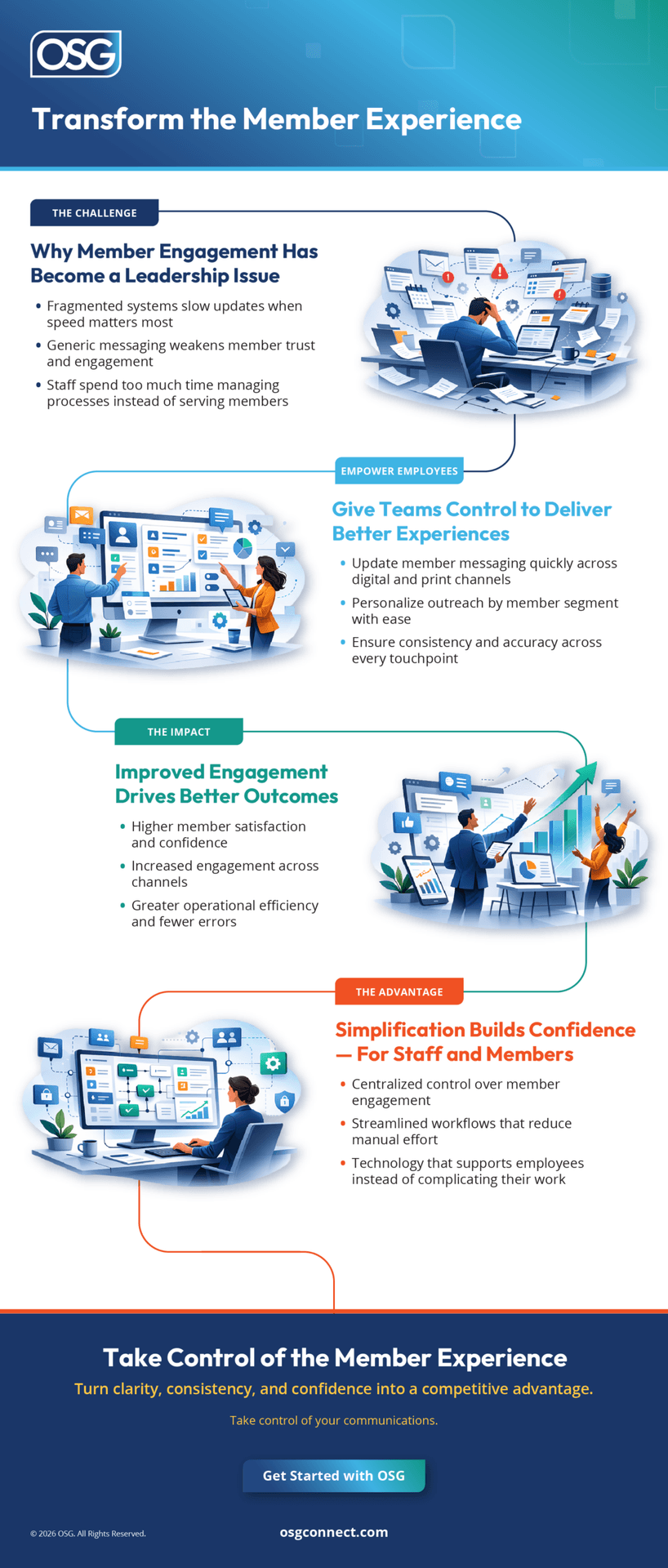

Why Member Engagement Has Become a Leadership Priority for Credit Unions
Member expectations have evolved – and they continue to rise. Today’s credit union members expect interactions that are accurate, timely, and easy to understand, while also feeling personal and relevant across every channel. At the same time, credit unions are navigating leaner teams, heightened regulatory scrutiny, and an increasingly complex mix of digital and print touchpoints.
This environment has elevated member engagement from a tactical function to a strategic leadership priority. When communications are difficult to update, inconsistent across channels, or overly manual, the impact reaches far beyond marketing. It affects member trust, compliance confidence, staff efficiency, and the overall experience the credit union delivers.
Credit unions that recognize member engagement as a strategic asset and empower their teams to manage it effectively are better positioned to adapt quickly, strengthen relationships, and deliver on their member-first mission.
Why Member Engagement Is Now a Strategic Asset
Members no longer judge their financial institution solely by rates, fees, or products. Every interaction – emails, statements, notices, and digital messagesshapes how members perceive the credit union and how much they trust it.
Clear, consistent, and relevant messaging reinforces confidence and credibility. Generic or poorly timed messaging can just as quickly erode trust.
For credit union leaders, a positive member experience is directly connected to:
- Member trust and loyalty
- Engagement across channels
- Long-term retention and growth
Organizations that treat member engagement as a strategic capability rather than a series of disconnected messages are better equipped to build strong, lasting member relationships.
The Operational Reality Credit Unions Face
Despite its importance, many credit unions struggle to deliver the engagement experience they want for members. Common challenges include:
- Cumbersome systems: Updating member messaging often requires multiple platforms, manual processes, or external resources, slowing response times when agility is critical.
- Limited personalization: One-size-fits-all messaging fails to resonate with today’s members and limits engagement.
- Staff burden: Employees spend excessive time managing updates and troubleshooting issues instead of focusing on meaningful member interactions.
These challenges are rarely the result of lack of effort. More often, they stem from fragmented ownership, outdated workflows, and unnecessary complexity that place added strain on already busy teams.
Empowering Employees to Deliver Better Member Experiences
When member engagement is simplified, employees gain more than efficiency – they gain confidence and control.
With the right approach, teams can:
- Update member communications quickly across digital and print channels
- Personalize messaging for specific member segments with minimal effort
- Maintain accuracy and consistency across every touchpoint
This empowers employees to spend less time managing processes and more time supporting members. When staff have clear ownership and easy-to-use tools, they become champions of the member experience rather than bottlenecks in the workflow.
OSG Perspective: Simplification Builds Confidence
Credit unions don’t struggle with member engagement because they lack commitment. They struggle because communication ownership, tools, and accountability are often fragmented across systems and teams.
True progress comes from simplification – centralizing control, reducing manual steps, and giving employees the ability to manage interactions confidently without adding complexity. When workflows are streamlined, updates happen faster, accuracy improves, and confidence increases for both staff and members.
The Impact on Members and the Credit Union
Credit unions that streamline engagement workflows and enable personalization see measurable benefits, including:
- Increased member satisfaction as messages feel more relevant and timely
- Greater engagement across digital and print channels
- Improved operational efficiency as staff spend less time on repetitive tasks
- Reduced errors and complaints through greater consistency and accuracy
The result is a stronger connection between members and the credit union -built on clarity, trust, and reliability.
Technology’s Role: Supporting Control, Not Adding Complexity
Technology should never overshadow the member experience, but it plays a critical role behind the scenes.
Solutions that centralize experience management, simplify workflows, and support personalization give credit union teams the control they need without increasing workload. The goal is not more technology, but better control, faster response, and greater confidence when changes are required.
When technology supports employees instead of complicating their work, engagement becomes a competitive advantage rather than a challenge.
A Leadership Challenge Moving Forward
For credit union leaders, the question is no longer whether member engagement matters – it’s whether the organization is set up to manage it effectively.
Consider:
- Who truly owns member engagement today?
- How quickly can your team respond when updates are needed?
- Are your tools empowering employees or slowing them down?
Credit unions that empower employees to take control of member engagement create differentiated experiences that drive trust and loyalty. By simplifying workflows, enabling personalization, and ensuring consistency across channels, every interaction becomes an opportunity to strengthen the member relationship.